
×
Home
Buy
Sell
Reviews
Compare
Specifications
Tips
News
Finance
Privacy
Terms & Conditions
© 2025 bdcars360.com

BYD Sealion 5 2025 vs Toyota Yaris Cross GX 2025
Change models to compare
Overview
|
Measurement
|
Engine
|
Chassis
|
Equipment
Overview|
Measurement|
Engine|
Chassis|
Equipment
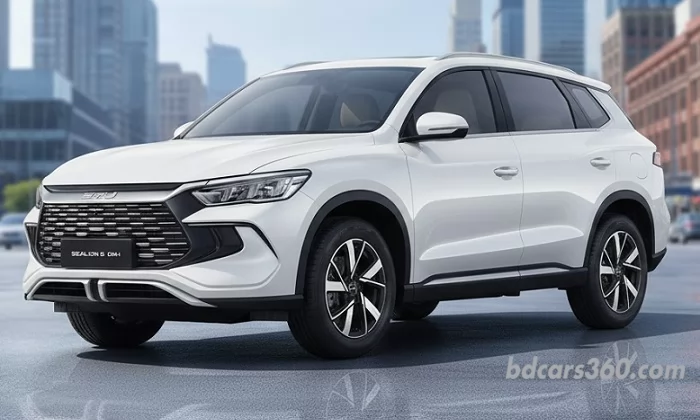 |  | Select car from above | |
|---|---|---|---|
| Criteria | BYD Sealion 5 2025 | Toyota Yaris Cross GX 2025 | |
| Make | BYD | Toyota | |
| Model | Sealion 5 | Yaris Cross GX | |
| Year | 2025 | 2025 | |
| Body Type | Compact Crossover SUV | Compact Crossover SUV | |
| Drive | FWD | FWD | |
| Transmission | E-CVT. | Electronically-controlled Continuously Variable Transmission | |
| Displacement | 1498 cc | 1498 cc | |
| In city Mileage | 20.6 km/L (approx. 4.85 L/100km) | 20.6 Km/L | |
| Out of city Mileage | 1,001 km combined range (for the 12.9 kWh battery) and the 1,030 km range (for the 18.3 kWh battery | 22.17 Km/L | |
| Luxury Car | Yes | No | |
| Electric Car | No | No | |
| Hybrid Car | Yes | No | |
| Sports Car | No | No |
| Criteria | BYD Sealion 5 2025 | Toyota Yaris Cross GX 2025 | |
|---|---|---|---|
| Length | 4738 mm. | 4180mm | |
| Width | 1860 mm | 1765mm | |
| Height | 1710 mm | 1590mm | |
| Wheel Base | 2712 mm | 2560mm | |
| Treads | Front tread (track): 1573 mm, Rear tread (track): 1582 mm | 1525mm | |
| Ground Clearance | 170 mm (Unladen) 150 mm (Laden) | 170mm | |
| Curb Vehicle Weight | approximately 1724–1749 kg | 1140kg | |
| Gross Vehicle Weight | Over 2100 kg. | 1600kg | |
| Seating Capacity | 5 | 5 | |
| Doors Number | 5 | 5 | |
| Minimum Turning Radius | 5.8 m | 10.6m | |
| Fuel Tank Capacity | 52 L | 36 Litres |
| Criteria | BYD Sealion 5 2025 | Toyota Yaris Cross GX 2025 | |
|---|---|---|---|
| Displacement | 1498 cc | 1498 cc | |
| Engine Model | 1.5 L L4 DOHC 16-valve | 1.5L L4 DOHC 16-valve | |
| Engine Type | 1.5L Naturally Aspirated Inline-4 (PHEV) | 3 Cylinders, In-Line, Dynamic Force, 12 Valve Double Overhead Cam | |
| Engine Info | 4 cylinder 16 valve | 4 cylinder 16 valve | |
| Max Power | 156kW | 67kW at 5500rpm | |
| Max Torque | 300Nm | 120Nm at 3800-4800rpm | |
| Top Speed | 170 km/h | 185 Km/h | |
| Fuel System | Port Fuel Injection + Direct Injection (Dual Injection system) | Gasoline Direct Injection | |
| Fuel Type | Premium unleaded (required) | Petrol, 91 or Higher | |
| Compression Ratio | 15.5:1 (Atkinson-cycle engine | 10.5:1 | |
| Final Gear Ratio | single-speed electric reduction system controlled electronically, which behaves like an E-CVT for smooth acceleration. | ||
| Turbocharger | No | Yes | |
| Bore | 72 mm | 80.5mm | |
| Stroke | 92 mm | 97.6mm | |
| Low Emission Vehicle | Yes | Yes | |
| Push Start | Yes | Yes | |
| Fast charge port type | Type 2(AC only) | ||
| Charging plug | AC Charging (home / slow charging),DC Fast Charging standard (market label): CCS2 (Combined Charging System Type 2) Type 2 (Mennekes) port, | ||
| Battery capacity | 12.90 kWh(standard / Comfort variant) | ||
| Time to charge battery | 3h 45m | ||
| Electric Motor Poower |
| Criteria | BYD Sealion 5 2025 | Toyota Yaris Cross GX 2025 | |
|---|---|---|---|
| Tire Size (Front) | 225/60 R18 | 205/65 R16 | |
| Tire Size (Rear) | 225/60 R18 | 205/65 R16 | |
| Power Steering | Yes | Yes | |
| Electric Steering | Yes | -- | |
| Braking System (Front) | Ventilated Discs | Ventilated Disc | |
| Braking System (Rear) | Solid disc | Solid Disc | |
| Suspension System (Front) | Macpherson Strut | MacPherson Strut with Stabiliser Bar | |
| Suspension System (Rear) | Multi-Link | Torsion Beam with Stabiliser Bar | |
| Wheel Rim | 18 Allow Wheel | 16-Inch Wheels |
| Exterior | BYD Sealion 5 2025 | Toyota Yaris Cross GX 2025 | |
|---|---|---|---|
| Sunroof | Yes | -- | |
| Front Fog Light | Yes | Yes | |
| Rear Fog Light | Yes | Yes | |
| Xenon Headlight | No | -- | |
| Projector Headlight | Yes | Yes | |
| Rear Wiper | Yes | Yes | |
| Front Spoiler | Yes | Yes | |
| Rear or Roof Spoiler | Yes | Yes | |
| Antilock brake system | Yes | Yes | |
| Traction control system | Yes | Yes | |
| Limited slip differential | -- | Yes | |
| Privacy Glass | Yes | -- | |
| UV cutting glass | Yes | -- | |
| Aluminium Wheel | Yes | Yes | |
| Interior | BYD Sealion 5 2025 | Toyota Yaris Cross GX 2025 | |
| Air Conditioner | Yes | Yes | |
| Wood Panel | No | Yes | |
| Cruise Control | Yes | Yes | |
| Centralized Door Lock | Yes | Yes | |
| Power Window | Yes | Yes | |
| Steering Wheel Telescopic | Yes | Yes | |
| Steering Wheel Tilt | Yes | Yes | |
| Leather Steering Wheel | Yes | Yes | |
| Power Front Seat | Yes | Yes | |
| Power Rear Seat | No | Yes | |
| Leather Seat | Yes | Yes | |
| Falling Down Type Rear Seat | Yes | Yes | |
| Child Seat Fixed With Seat Belt | Yes | -- | |
| Rear ELR3 Point Seat Belt | Yes | -- | |
| Front Seat Pretensioner Seat Belt | Yes | -- | |
| Fourth Limited Front Seat Belt | -- | -- | |
| Side Impact Bar | Yes | Yes | |
| Airbag (Driver) | Yes | Yes | |
| Airbag (Passanger) | Yes | Yes | |
| Airbag (Side) | Yes | -- | |
| Audio Deck | -- | Yes | |
| CD-player | No | -- | |
| Car Navigation System | Yes | Yes | |
| More Infotainment Features | Rotating Display: The central screen rotates for optimized viewing of apps, navigation, and media. Connectivity & Apps: Wireless integration for Apple CarPlay and Android Auto, along with 4G connectivity for on-the-go access. User Interface: Features a 3D effect on the dashboard, with a small, focused digital driver's display. Controls: Integrated voice control system for hands-free operation and remote climate control via the BYD App. Charging Capabilities: Includes USB-C and USB-A ports for passengers, along with a Qi wireless fast charger. V2L Technology: The system supports Vehicle-to-Load, allowing the battery to power external electric devices. Front Fog Light: Most trims use high-intensity LED daytime running lights built into the headlamp housing instead of separate lower fog lamps. | Bluetooth Bluetooth capability allows drivers to connect to compatible mobile phones and other devices to the internal audio system. Handsfree Telephone Enjoy the convenience and safety of Handsfree Telephone technology when making phone calls while inside your vehicle. Voice Recognition Command your audio with a fully integrated Voice Recognition system. Miracast When a mobile device that supports Miracast is connected to the vehicle via Wi-Fi Direct, its screen can be shown on the multi-media display and audio from the device can be output through the speakers. For safety reasons, only audio is output while the vehicle is in motion. Audio Streaming Bluetooth Audio Streaming technology lets you play your favourite music straight from your compatible audio device. USB Connectivity & Device Charging 1 x USB Apple CarPlay® and Android Auto™ Simply connect your smartphone to the multimedia display to make calls, listen to music and navigate using your favourite apps. Bringing convenience and connectivity Apple CarPlay® and Android Auto™ gives you a customisable driving experience. | |
| More Safety Features | Airbags Autonomous emergency braking Blind spot alert Collision warning Electronic stability control Lane departure warning Lane keeping assist Parking sensors Rear cross traffic alert Rear parking camera Side door exit warning Speed limiter | Pre-Collision System with Autonomous Emergency Braking, Pedestrian and Cyclist Detection, Intersection Turn Assist and Emergency Steering Assist The Pre-Collision System uses a radar sensor and a camera to determine whether a frontal collision with another vehicle, pedestrian or cyclist is imminent. Intersection Turn Assistance is designed to help prevent an accident when turning at an intersection and crossing the path of an oncoming vehicle or when a pedestrian is detected. If the system detects a frontal collision may occur it will warn you with an audio and visual alert to urge you to take evasive action. It then prepares the Brake Assist system to provide maximum braking assistance and if you do not brake in time it may also automatically apply the brakes to help you avoid the collision or reduce the speed of the impact. Emergency Steering Assist supports the driver in an emergency situation where there is the possibility of a collision with a pedestrian and the driver makes an evasive steering manoeuvre. Emergency Steering Assist provides additional steering torque to help the driver maintain control of the vehicle and also to help prevent lane departure. All-speed Dynamic Radar Cruise Control with Indicator-Linked Control and Road Sign Assist All-speed Dynamic Radar Cruise Control helps make driving safer by keeping a constant pre-set distance between your vehicle and the vehicle ahead, enabling you to pay more attention to the road conditions and the vehicles surroundings. All-speed Dynamic Radar Cruise Control maintains an adjustable vehicle-to-vehicle distance by automatically accelerating up to a set speed, decelerating or stopping your vehicle to match the speed changes of the vehicle ahead without having to use the accelerator or brakes. If the vehicle ahead stops, your vehicle will also stop while maintaining the appropriate vehicle-to-vehicle distance. After the vehicle ahead starts off, pushing the +RES switch on the steering wheel or depressing the accelerator pedal will cause your vehicle to start off & vehicle-to-vehicle distance control will resume. When overtaking the Linked Control function allows your vehicle to start accelerating as soon as the indicators are engaged. This provides smoother & faster overtaking as the All-speed Dynamic Radar Cruise Control system does not need to wait until the preceding vehicle is out of sensor range before accelerating. By using the speed limit information recognised by the Road Sign Assist system, the driver can quickly adjust the set speed to the indicated speed limit. When an upward or downward arrow appears on the road speed sign pictured in the Multi-Information Display, the set speed can be changed by selecting SET or +RES switch on the steering wheel. Automatic High Beam Automatic High Beam is designed to help improve forward visibility when driving at night by making maximum use of the high beam headlights. The system uses a camera to detect the headlights and taillights of vehicles ahead, or bright environments such as city streets, and automatically switches between high beam and low beam as required to avoid dazzling other drivers. Lane Tracing Assist Lane Tracing Assist is designed to reduce the possibility of an accident due to your vehicle unintentionally drifting out of its lane. The system recognises visible white and yellow lane markings and can recognise the roadside even when there is no lane marking. If it detects the possibility of lane departure, it will urge you to steer back into the lane using a warning buzzer and a visual display. The system can also provide assistance by applying a small force to the steering wheel for a short time to help the driver keep the vehicle in its lane. If the system detects the vehicle is swaying (or wandering) within its lane, which is often the result of a driver who is tired, distracted or not looking ahead, a warning buzzer sounds and the decrease in attention is shown using a display on the dash. When the Dynamic Radar Cruise Control system is operating, Lane Tracing Assist applies a force to the steering wheel to help the driver keep the vehicle in the centre of its lane. If the camera sensor cannot recognise lane markers, the system can continue to keep the vehicle in the centre of its lane using the path of the preceding vehicle. Road Sign Assist Road Sign Assist monitors road speed signs using a camera and then displays the current speed limit to the driver via the Multi-Information Display and Head-Up Display (if equipped). The system can be configured to provide an audio and/or visual alert if the vehicle speed exceeds a designated threshold above the posted limit. Active Cornering Assist Active Cornering Assist helps to reduce understeer when cornering. If understeer is detected, such as when turning at high speed with the accelerator pedal depressed, the system will brake the inner wheel (or wheels), causing the vehicle to rotate slightly around its centre axis and help it to follow its intended path around the corner. Anti-lock Braking System Anti-lock Braking System (ABS) modulates the brake pressure during an emergency stop or if the brakes are applied on a slippery surface to prevent the wheels from locking. This allows the driver to maintain steering control while braking to help avoid a collision. Blind Spot Monitor Blind Spot Monitor (BSM) uses radar sensors to detect vehicles present in the driver’s blind spots (areas that cannot be seen using the outer mirrors alone). When the system detects that a vehicle is present in a blind spot, it will inform the driver by illuminating the BSM indicator light in the corresponding outer mirror. If the indicators are operating, the BSM light flashes to provide a more urgent warning. Brake Assist Brake Assist (BA) measures the speed and force with which the brake pedal is pushed to determine whether the driver is attempting an emergency stop. If the system determines that the brake pedal is not being depressed with sufficient force, Brake Assist operates to automatically increase the brake pressure enabling the brakes to operate at maximum efficiency for the conditions. Drive-Start Control Drive-Start Control is designed to help prevent or reduce low speed accident damage if the driver operates the gear lever while depressing the accelerator pedal. If this type of abnormal gear changing is detected, Drive-Start Control suppresses the power output of the engine or hybrid system to keep the vehicle’s speed and acceleration below a predetermined level and warns the driver with a light and a message on the dash. Electronic Brake-force Distribution Electronic Brake-force Distribution (EBD) distributes the braking force between each wheel to maximise braking to the wheels with the most grip, according to the driving conditions and the load in the vehicle. It senses the weight distribution of the vehicle and redistributes the amount of braking to each wheel so that the wheels with most weight on them receive the most brake force. Emergency Stop Signal The Emergency Stop Signal system rapidly blinks the stop lights or the hazard lights (depending on the model) to warn following drivers when emergency braking is occurring. The system operates when the vehicle’s speed is above approximately 55km/h and a significant deceleration force is detected. Hill-start Assist Control Hill-start Assist Control (HAC) is designed to help minimise backward rolling on steep ascents. Secondary Collision Brake The Secondary Collision Brake system is an autonomous emergency braking function designed to reduce damage or injury from a secondary collision, which can occur if the driver is unable to apply the brakes themselves after an initial impact. If a collision is detected while the vehicle speed is approximately 10 km/h or more and the airbags are deployed, and if the braking system is sufficiently intact, the system operates the brakes and tries to bring the vehicle to a stop. Simultaneously a signal is sent to illuminate the stop lights. Traction Control The Traction Control (TRC) system monitors the speed of all four wheels. If any of the drive wheels begin to slip during acceleration, TRC slightly applies the brakes to the slipping wheel(s) and reduces the power output of the engine or hybrid system to maintain traction. Vehicle Stability Control With Crosswind Assist Vehicle Stability Control (VSC) compares the vehicle's direction of travel with the driver's steering, acceleration and braking inputs. If the vehicle is deviating from the intended direction, VSC is designed to warn the driver, reduce the power output of the engine or hybrid system and control the brakes to help the driver maintain their intended path. Crosswind Assist is a safety system designed to help prevent unintended lane departure when the vehicle is hit by a sudden crosswind. Based on information from the speed sensors, yaw rate sensor, acceleration sensor and steering sensor, when the system detects a significant deviation of the vehicle from its current path, it determines that it has been affected by a crosswind. The system then calculates the necessary brake force required according to the vehicle speed and the intensity of the deviation and operates the front and/or rear brakes on the side of the vehicle that is hit by the crosswind. As a result, the yaw moment caused by the crosswind is reduced and the time before the driver needs to make steering corrections is extended, helping to prevent the vehicle deviating from its lane. | |
| More info | The BYD Sealion 5 DM-i is marketed with an E-CVT transmission, but unlike a traditional belt-driven CVT, BYD’s DM-i system primarily uses a single-speed electric direct-drive setup with hybrid power management to deliver smooth, seamless acceleration Battery type-LFP Blade Battery AC charging time (15-100%)- 4.5h (comfort), 6h (Design) |
Follow Us On




© 2026 bdcars360.com. All rights reserved.